Showing posts with label Nearline. Show all posts

First Step for LTO-6


Availability of licenses now, tomorrow for drives and media
The Linear Tape-Open Program Technology Provider Companies - HP, IBM and Quantum - announced the availability of licenses for the LTO Ultrium Generation 6 format. 

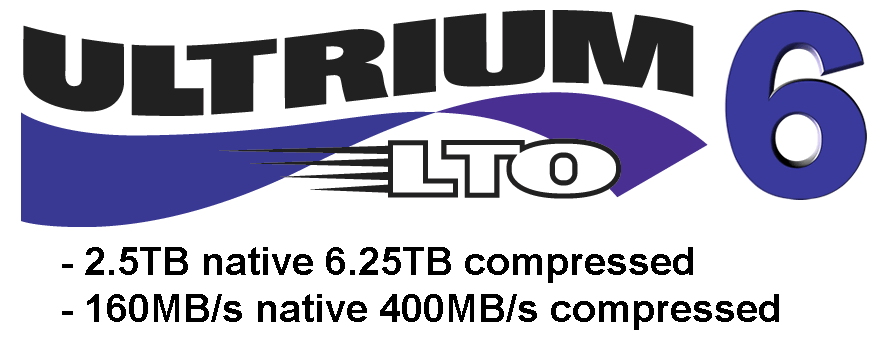
Plans for specifications for the Generation 6 tape cartridge include capacity of up to 8 TB, almost triple the capacity over the previous generation, and tape drive data transfer rates of up to 525 MB per second, assuming a 2.5:1 compression with use of a larger compression engine history buffer. 

Also included are features from previous generations of the LTO Ultrium format, such as encryption to help protect data in transition, Write Once Read Many (WORM) support to help address data security and compliance needs, as well as the dual partitioning feature, introduced in Generation 5, which when utilized by the Linear Tape File System specification can help provide faster data access and improve data management.

"LTO technology's latest advancement was developed with the understanding that tape-based archiving continues to be a critical component of clients' overall storage strategy," said Chris Powers, director of Nearline Solutions, HP. "LTO Generation 6 enables vendors to deliver storage solutions with performance benefits as well as increased data capacity." 

Plans for LTO Ultrium 6 drive specifications include backwards-compatible read-and-write capability with LTO Ultrium 5 cartridges, and backwards-compatible read capabilities with LTO Ultrium 4 cartridges, helping to protect investments and ease implementation.

How to License LTO Ultrium Technology
The LTO Program offers several different license packages - from enhanced packages that provide the specifications and licenses to manufacture LTO Ultrium products, to basic packages providing LTO Ultrium format specifications.


Our comments :

The announcement of LTO-6 specs for licensing is a first step for the new format. For former LTO-5, it was revealed in January 2010 or 18 months ago, and the first LTO-5 tape drives from HP and IBM were launched three months later. It took three years to jump from LTO-4 to LTO-5.

Native capacity and transfer rate for LTO-6 media are 3.2TB and 210MB/s respectively for LTO-6, vs. 1.5TB and 140MB/s for LTO-5. It's more than twice the capacity now at the same level as current highest capacity HDDs (3TB). The transfer rate increased 50%. This time the LTO consortium previews "a 2.5:1 compression with use of a larger compression engine history buffer." It was 2:1 for LTO-5. No information was given at all on the new technologies used to increase the specs of LTO.

As usual the latest generation can read and write the former one and read only LTO-3.

Next one LTO-7 is supposed to be once more 2x the capacity (6.4TB) with 1.5x more for transfer rate (315MB/s) but we don't know when, to be followed by LTO-8, the last one (12.8TB, 472MB/s) on the roadmap.

LTO is the last evolving tape technology as we doubt that HP will continue to push 8mm helical scan DDS/DAT beyond current DAT 320 format (native 160GB and 12MB/s). All the other ones are dead but half-inch tape cartridges for mainframes from IBM (3599, native 4TB, 250MB/s) and Oracle/Sun (T10000C, native 5TB - record capacity for tape media -, 240MB/s).

This market is declining and tapes are definitively going to be used only for massive archiving and no more for backup in the next future.

These icons link to social bookmarking sites where readers can share and discover new web pages.
  • Digg
  • Sphinn
  • del.icio.us
  • Facebook
  • Mixx
  • Google
  • Furl
  • Reddit
  • Spurl
  • StumbleUpon
  • Technorati

Near-line storage


Near-line storage is the on-site storage of data on removable media. The removable storage idea dates back to the mainframe computer and, in the age of the smaller computer, remains popular among individuals, small businesses, and the large enterprise.


There are three major categories of near-line storage: magnetic disk, magnetic tape, and compact disc (CD). Magnetic disks include 3.5-inch diskettes, and various removable media such as the Iomega ZIP disk and the Syquest disk. Tapes are available in almost limitless variety. Examples of media in the CD category are CD recordable (CD-R), CD rewriteable (CD-RW), and digital versatile disc rewriteable (DVD-RW).


Near-line storage provides inexpensive, reliable, and unlimited data backup and archiving with somewhat less accessability than with integrated online storage. For individuals and small companies, it can be an ideal solution if the user is willing to tolerate some time delay when storing or retrieving data. Near-line storage media, when on the shelf, are immune to infection by online viruses, Trojan horses, and worms because the media are physically disconnected from networks, computers, servers, and the Internet. When a near-line storage medium is being employed to recover data, it can be write-protected to prevent infection. If an infected computer is used to write data onto a near-line storage disk, tape, or CD, the medium may also become infected. It is suggested that near-line storage media always be scanned with an anti-virus program before use.


Advantages of online storage over near-line storage include near-zero access delay, simultaneous availability to a large number of users, and ease of centralized management.


Contributor(s): Dave Pridgeon


This was last updated in September 2005


Posted by: Margaret Rouse

These icons link to social bookmarking sites where readers can share and discover new web pages.
  • Digg
  • Sphinn
  • del.icio.us
  • Facebook
  • Mixx
  • Google
  • Furl
  • Reddit
  • Spurl
  • StumbleUpon
  • Technorati

New LTFS Technology Boosts The Reliability of Your LTO Ultrium 5 Systems


hp_storageworks_lto5_ultrium

Today's data centers have become multi-functional. They face a series of new challenges like fast data growth, intense competition, time-critical applications and of course, the data retention laws (SEC, HIPAA etc.). Creating data backups provides you complete peace of mind and ensures business continuity. Therefore, data corruption or even complete loss of business-critical information won't cause any interruptions, as you can utilize the backup data. Organizations that need to store, manage and share large volumes of data turn to the firmly-established LTO (Linear Tape Open) technology's newest generation, known as LTO ultrium 5. Multi-vendor compatibility is the most compelling feature of LTO solution that makes it more cost-efficient and also the frontline technology in tape industry.

HP Hewlett-Packards has decades of experience in backup storage industry and is also co-inventor of this intelligent LTO format. HP LTO5 system satisfies the backup requirements for large-scale data centers, mid-sized companies, video applications, complex workgroups, large databases and advanced E-business applications. LTO5 tape, featuring the same physical size of LTO4 backup tape, can squeeze almost double the data volume. LTO5 ultrium tape stores 1500GB data, which is equivalent to 1.50 terabytes. Data compression will further provide a 100% increment, thus enhancing it to 3.0 terabytes. So, lesser quantity of these high-capacity LTO5 tapes will backup your enormous databases, and will save you more shelf space.

LTO5 ultrium solution supports the demanding needs of busy IT environments, and offers new breakthrough LTFS (Linear Tape File System) that makes data management more efficient, flexible and easy like using a USB flash drive. I.T staff can copy/paste data from the host system or just drag-drop them. Never before, the backup operations with tape-based systems were so flexible and easy. LTFS innovation enables LTO-5 customers to manage the media-rich applications including CAD/CAM, video surveillance and Health industry. This exclusive feature has made LTO-5 an industry-favorite tape solution for data intensive organizations.
HP's new super-fast internal & external LTO5 drives allow fast connectivity to the advanced systems. Users can be assured of greater compatibility, because HP has also introduced the industry-leading SAS and SCSI connectivity options. Maximum backup speed achieved by HP LTO5 drives is 140/280 Mbps, which is simply unrivaled.

To help overcome the common issue of fluctuating in-coming data rate, which can degrade performance and increase error rate, HP has introduced a smart "data rate matching" feature in its high-performance LTO 5 drives. The speed of drive automatically alters with the in-coming data rate to provide a perfect match. This innovative functionality elevates the performance and completes data backups with superior reliability. HP LTO 5 system brings to you a wide range of advantageous features and the ability to pack mountains of data in a small footprint.
Rob Millar is the marketing manager of Tape4backup and markets hp lto5 tape and hp c7975a. He has vast experience in the marketing and trading industries and has been helping buyers who have the backup needs and guide clients about the technology.

These icons link to social bookmarking sites where readers can share and discover new web pages.
  • Digg
  • Sphinn
  • del.icio.us
  • Facebook
  • Mixx
  • Google
  • Furl
  • Reddit
  • Spurl
  • StumbleUpon
  • Technorati

How to Find Quality Tape Library Repair Services


Tape libraries are a smart way for small and large businesses to store proprietary data, especially if it needs to be kept safe, secure and accessible. But even with the best tape drives, libraries can experience failures. Does this mean it is time to get a new one, or upgrade to that really expensive hard drive storage your neighbor has at his business?

Not quite yet. Companies specializing in tape library repair are out there and there is a good chance that they will be able to fix what is broken quickly for a fraction of the cost. Best part is, you most likely will not need any new hardware.

While tape library tuneups are quite common, you want to make sure you find a reliable repair service that does no further damage to your tapes and does not attempt to overcharge you. Here's a look at the type of repair work and services available so you have an idea of what you're in for.

Initial diagnosis. Look for companies that do preliminary diagnoses for free. This will tell you whether or not they stand behind their services. Ask the company or individual repair person to provide you with a quote for the cost of repairs. Most of these diagnoses can be done over the phone or email.

Quick turnaround time. Data storage malfunctions can present a major problem for businesses that rely on storage to keep their business running. Even if data storage isn't a primary function of your business, having a tape library that is running efficiently is crucial. Find a company that provides expedited service, even repairs that can be done within one day.

Firmware check. It is likely your firmware is outdated and needs to be upgraded. Most companies will do this for free with a standard repair service.

Documentation. Your repaired tape libraries should be tested before they are returned to ensure they're performing as well as they should be. Good companies will be happy to provide you with a testing report along with your refurbished equipment or parts.

Repair warranty. This is a given but can surprisingly be overlooked. Look for repair services that back their work with at least a 6-month warranty.

As long as you keep these few things in mind when looking for companies to repair your tape libraries, you will be in good shape. You can also check online discussion forums to see what people other people are saying about various businesses.

Drew is a freelance writer from Columbus, Ohio, who writes about the best tape drives and everything in between. Drew also writes about Magnext and Magnext tape library repair.

r

These icons link to social bookmarking sites where readers can share and discover new web pages.
  • Digg
  • Sphinn
  • del.icio.us
  • Facebook
  • Mixx
  • Google
  • Furl
  • Reddit
  • Spurl
  • StumbleUpon
  • Technorati